

Years of high prices and tight budgets should have pushed Americans toward visible financial trouble by now. A record $18.8 trillion in household debt seems to back that up, according to the Federal Reserve Bank of New York.
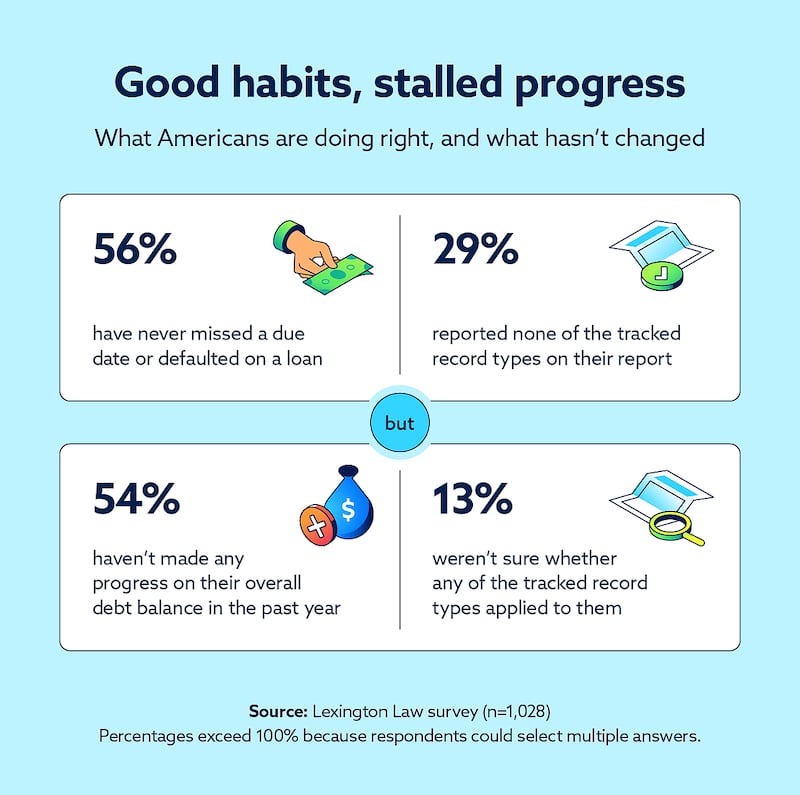
However, a new Lexington Law survey of 1,028 U.S. adults shows that most people are keeping up, with more than half (56%) saying they've never missed a payment or defaulted on a loan. Twenty-nine percent of respondents also noted that none of the record types listed in the survey, from missed payments to hard inquiries, show up on their credit report.
But keeping up isn't the same as getting ahead. Fifty-four percent haven't made any progress on their overall debt in the past year. And as Lexington Law reports, those with the lowest incomes or credit scores aren't driving that figure.
Key Takeaways
- Fifty-four percent of Americans haven't reduced their overall debt balance in the past year.
- Fifty-six percent have never missed a due date or defaulted on a loan.
- Middle-income households report the highest rate of growing credit concern, at 31%.
Three in four Americans carry debt
About three in four households carry some kind of debt. Credit cards top the list at 43%, followed by mortgages (27%), auto and similar loans (22%), and personal loans (19%).
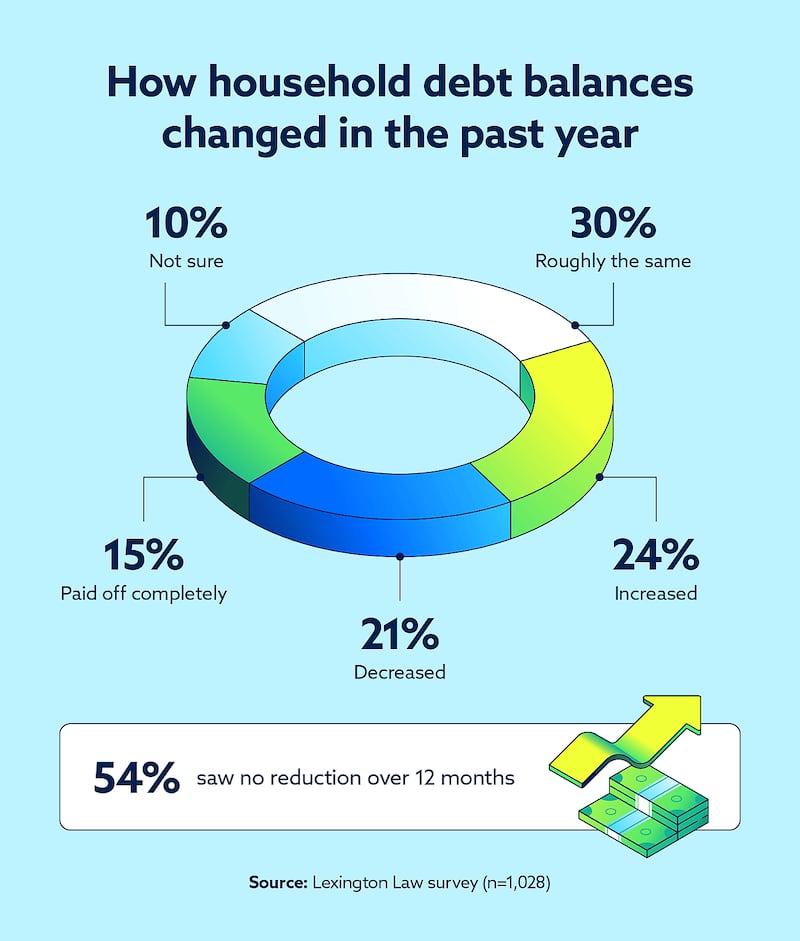
What’s more, most people aren’t making a dent in what they owe. Forty-one percent owe at least $10,000 outside of a mortgage. And 30% said their balance stayed about the same over the past year, while 24% said it went up. Only 21% saw their balance go down, and just 15% paid it off completely.
Lexington Law
Paying on time doesn’t always pay down the balance
If debt were really spiraling, there’d be missed payments and reports full of collections. That’s not what the survey found.
Most respondents actually have a clean payment record, and nearly 3 in 10 said that none of the record types the survey asked about showed up on their credit report.
People are paying on time, but minimum payments don’t move the principal much, especially when interest rates are high. You can pay every bill on time for a year and still see hardly any change.
Lexington Law
Another 13% of respondents actually weren’t sure if any of the listed record types applied to their report, suggesting they could have something in their report that they don’t know about.
44% of people who missed a payment saw their score drop
Not everyone has stayed on top of their payments: 45% of respondents reported missing a due date or defaulting at some point.
Among this group, 44% saw their credit score fall, just as many paid a late fee, and 40% saw the missed payment on their credit report or had the bill go to collections (32%).
The more severe outcomes were less common but harder to undo: 13% had something repossessed, 11% enrolled in a debt consolidation program, and 7% filed for bankruptcy. And each of these long-term outcomes started with a single missed due date.

Lexington Law
Despite the impact of these outcomes, only 17% called their lender to negotiate. This is despite the fact that negotiating can help even when a debt is legitimate, and is crucial when you're attempting to remove a late payment that shouldn't be there in the first place.
Middle-income earners are the most worried about their credit
Households earning $50,000 to $99,999 worry most about credit. Thirty-one percent said they’re more concerned about their credit than they were a year ago, compared with 24% of those earning under $50,000 and 20% of those making $100,000 or more.
Credit score groupings are a bit more predictable. Thirty-nine percent of people with fair credit said they’ve grown more concerned about their score. As scores go up, that share drops, down to 12% for people with excellent credit. People with poor credit also reported high concern, but the surveyed subgroup was smaller.
The fair-credit group is also the most likely to carry credit card debt (52%) and buy now, pay later balances (21%). What’s more, 67% of this group said their balance stayed the same or went up, the highest of any score group surveyed.
This suggests that the people who worry most have something to lose and not much room for a setback.
Why it’s worth checking your credit report
As with many people in this survey, if paying on time isn’t moving your balance, your credit report is the next place to look.
You can pull your credit reports weekly from each of the three main credit bureaus at annualcreditreport.com. Checking them regularly makes it easier to catch problems as soon as they appear. Under the Fair Credit Reporting Act, you have the right to dispute information you believe is inaccurate or incomplete, and the credit reporting agencies are responsible for investigating legitimate disputes.
If you find an error, write down the account number, date, reported status, and which bureaus are showing it, since the same account can look different from one bureau to the next. Keep copies of every dispute you send and every response you get.
Methodology
This survey was conducted online by Centiment on behalf of Lexington Law, Aug. 12-17, 2026, among 1,028 U.S. adults aged 18 and older. Data is unweighted. Select all that apply percentages reflect individual response rates and should not be summed. Some figures and comparisons are based on subgroups, such as respondents who missed a payment or defaulted (n=457) and respondents with poor credit (n=92), which carry a wider margin of error. The margin of error is approximately plus or minus 3% for the full sample at the 95% confidence level.
This story was produced by Lexington Law and reviewed and distributed by Stacker.